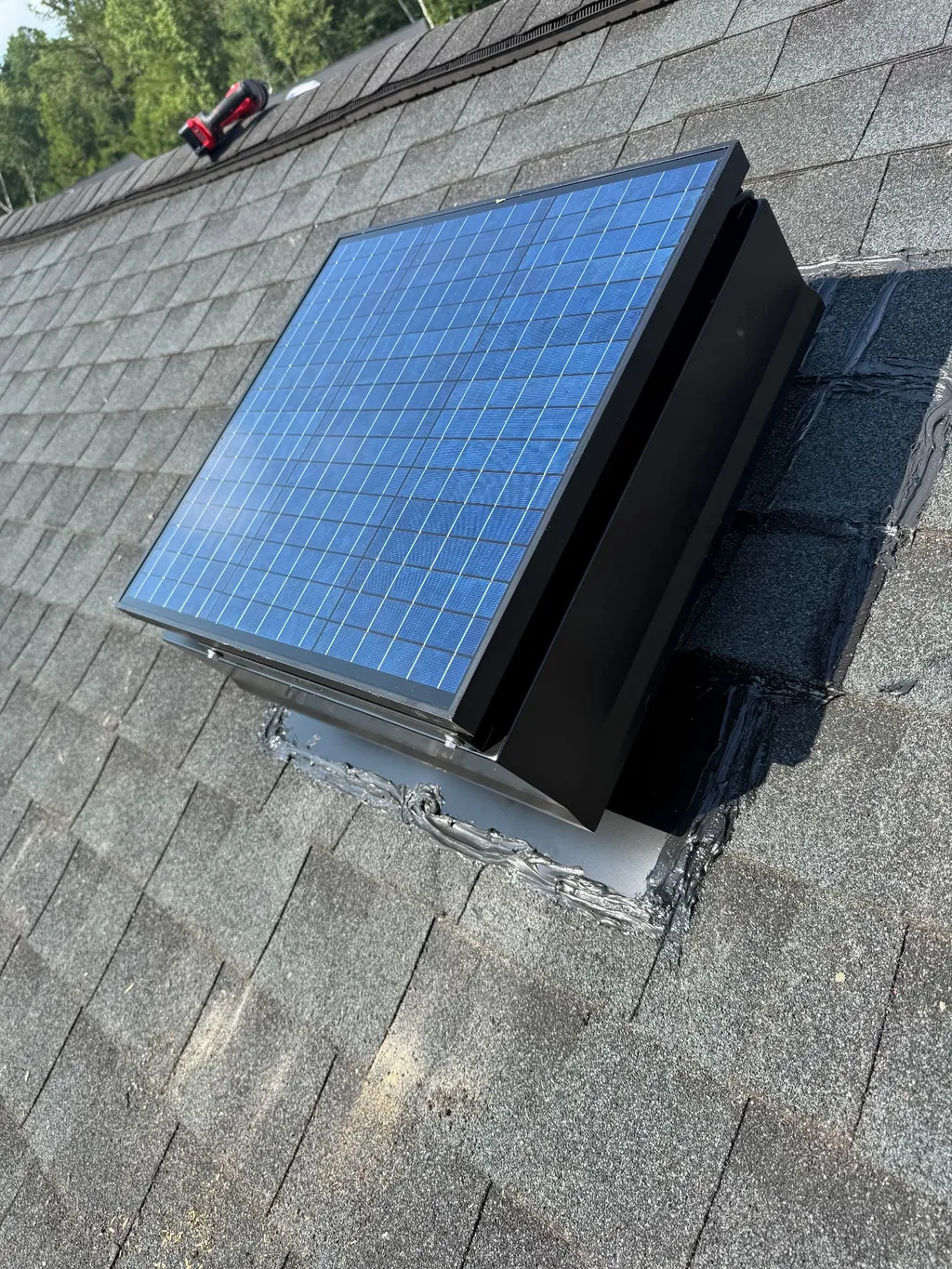
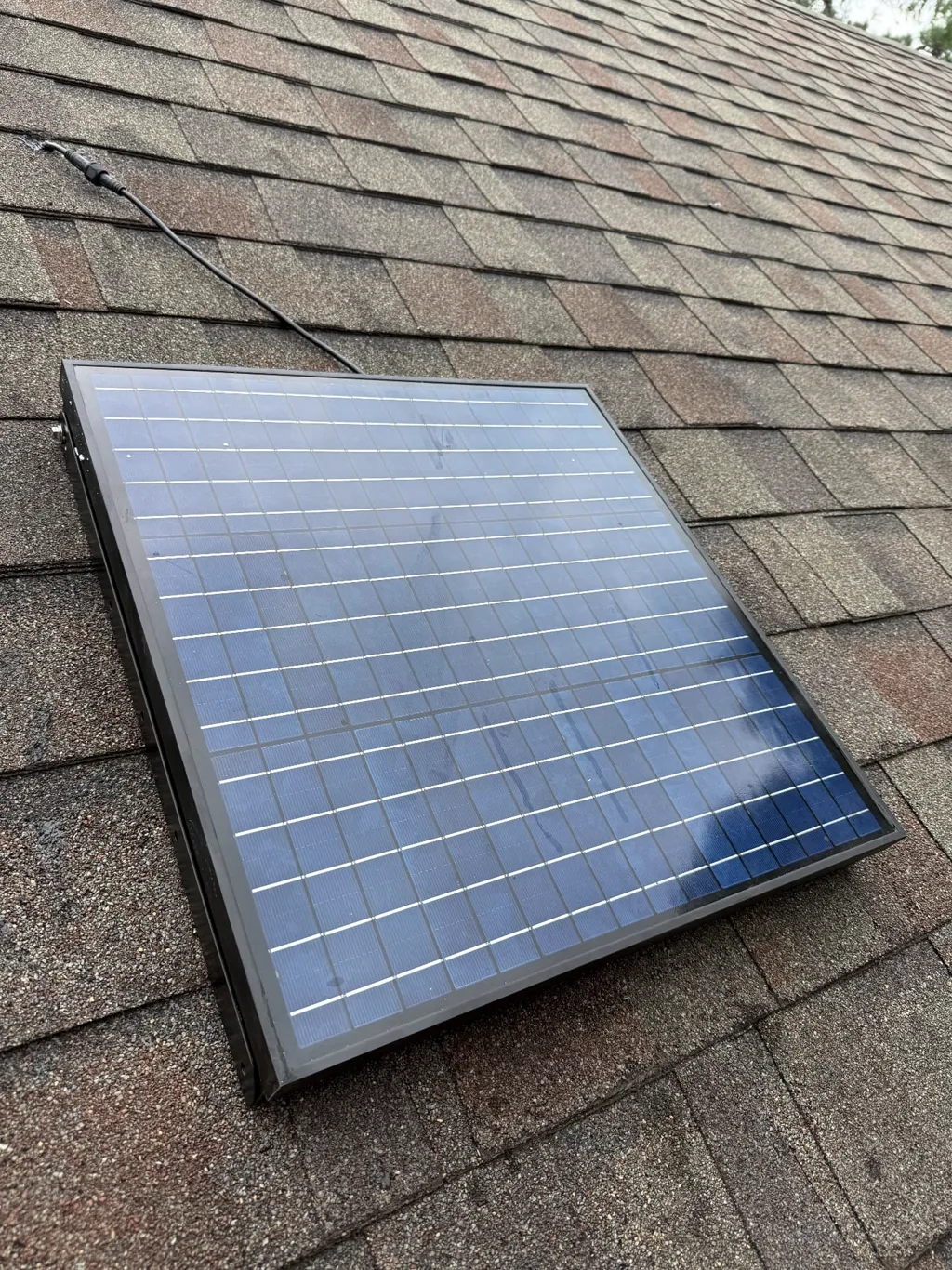
Professional roof-mounted and gable-mounted solar attic ventilation for Savannah, Coastal Georgia and the South Carolina Lowcountry. Roof Doctors evaluates airflow, intake ventilation and solar exposure before recommending the right setup for your attic.
Solar ventilation matched to the attic and exterior
Attics can hold heat and moisture-laden air. Roof-mounted fans exhaust through the roof surface, while a gable-mounted system can use a suitable gable opening and a separately positioned solar panel. Roof Doctors reviews the attic layout, existing ventilation, roof or gable conditions, and solar exposure before recommending a configuration.
Gable-mount option
Where the building has a suitable gable and ventilation layout, a gable-mounted fan can provide powered exhaust without placing the fan through the roof surface. The solar panel is positioned for available sunlight, and final suitability depends on the complete attic ventilation plan.
The Basics
What Is a Solar Attic Fan?
A solar attic fan is a powered exhaust fan that uses energy generated by a small photovoltaic panel rather than drawing household electricity while sufficient sunlight is available. The fan is designed to move attic air outdoors.
But adding a fan is not as simple as cutting a hole in the roof and turning it on. For attic ventilation to work properly, air needs a complete pathway. If intake ventilation is blocked or insufficient, adding a powerful exhaust fan may not produce the intended result.
That is why Roof Doctors evaluates the entire ventilation path before recommending a solar attic fan.
The airflow path
01
Soffit / Lower Intake
Outside air enters through lower intake vents.
02
Attic Airflow
Air moves up and across the attic space.
03
Solar Fan Exhaust
The fan exhausts attic air outdoors.
Coastal Climate
Attic Ventilation in Savannah's Hot, Humid Climate
Savannah homes experience long periods of heat and high humidity. During sunny weather, roof surfaces absorb solar heat and attic temperatures can rise significantly.
Ventilation can help exchange attic air in an appropriately designed vented attic, but ventilation is only one component of attic performance. Insulation, air sealing, intake ventilation, exhaust ventilation and the location of HVAC equipment all matter.
DOE guidance cautions that powered attic fans can pull conditioned air from the house when the ceiling between the home and attic is not adequately air sealed.
Roof Doctors looks at the attic as a system rather than assuming every hot attic simply needs a fan.
Operation
How Does a Solar Attic Fan Work?
When sufficient sunlight reaches the solar panel, electricity generated by the panel powers the fan motor, and the fan exhausts attic air outdoors. The system does not require the fan motor to draw power from the home's electrical system during solar operation.
The 30W Attic Depot models Roof Doctors offers also include automatic temperature and humidity controls. According to the manufacturer, the 30W roof-mount model is designed to activate at approximately 85°F and turn off near 70°F, while its humidity control activates at approximately 75% relative humidity and turns off near 60%, when adequate solar energy is available.
Two Configurations
30W Roof-Mounted vs. 30W Gable-Mounted Solar Attic Fans
Roof Doctors offers The Attic Depot 30W roof-mounted and 30W gable-mounted solar attic fans. Both use a variable-speed brushless motor and need no household electrical connection.
30W Roof Mount
The fan and solar panel operate as one integrated rooftop system, installed through an appropriate location on the roof surface. Includes a protective wildlife screen.
Airflow
Up to 1,550 CFM
Recommended attic size
Up to approx. 1,500 sq. ft. (manufacturer)
Solar panel
Adjustable 30-watt panel, integrated
Mounting style
Through the roof surface, low-profile
Temperature control
Automatic thermostat
Humidity control
Automatic humidistat
30W Gable Mount
The fan installs at an appropriate gable opening, with a separate panel placed where it can receive suitable sunlight. A good option where mounting through the roof is less desirable.
Airflow
Up to 1,550 CFM
Recommended attic size
Up to approx. 1,500 sq. ft. (manufacturer)
Solar panel
Remote 30-watt panel
Mounting style
At a gable opening; no roof penetration for the fan housing
Temperature control
Automatic temperature control
Humidity control
Automatic humidity control
Not sure which one fits your home? Let Roof Doctors evaluate the attic.
A Solar Attic Fan Needs Somewhere to Pull Air From
A fan removes air. Something has to replace it. In a properly designed vented attic, replacement air should enter through appropriate intake ventilation such as soffit vents and move toward the exhaust point.
If those vents are blocked by insulation, undersized or otherwise ineffective, simply adding more exhaust capacity does not fix the airflow problem. The manufacturer itself instructs installers to evaluate soffit ventilation, baffles, rafter channels, obstructions and existing exhaust vents first.
“The goal isn't to install the biggest fan possible. It's to create the right airflow for the attic.”
That is why Roof Doctors evaluates:
Intake ventilation
Existing roof and gable vents
Insulation placement
Ventilation baffles
Attic layout
Proposed fan location
Available solar exposure
Air sealing between the home and attic
Air Sealing First
Why Air Sealing Matters Before Adding Powered Attic Ventilation
A powered exhaust fan creates negative pressure inside the attic while it operates. If the attic floor contains significant openings into the house, the fan may pull air through those openings instead of only drawing replacement air through the intended attic vents. That can mean conditioned indoor air is pulled into the attic.
Before installing a fan, Roof Doctors can evaluate accessible attic air leakage and determine whether home air sealing should be part of the project.
Different Jobs
Does a Solar Attic Fan Replace Insulation?
No. Ventilation and insulation perform completely different jobs. A homeowner can have excellent ventilation and inadequate insulation, or excellent insulation and a ventilation problem. If your attic is uncomfortable or underperforming, the right solution may involve air sealing, additional insulation, correcting blocked intake ventilation, a solar attic fan, or a combination of these.
Solar Attic Fan
Moves air through an appropriately vented attic.
Insulation
Slows heat transfer between the attic and living space.
Air Sealing
Reduces unwanted air movement between the home and attic.
The attic, intake ventilation, exterior mounting options, and solar exposure are evaluated.
02
A roof-mounted or gable-mounted configuration is recommended for the available conditions.
03
Available sunlight powers the fan to move attic air outdoors without drawing household electricity.
Common Concerns
Humidity, Weather and Noise
Can a Solar Attic Fan Help With Attic Humidity?
The 30W systems Roof Doctors offers include humidity-responsive controls designed to operate when attic humidity rises above the manufacturer's threshold and adequate solar power is available. Moving air through an appropriately ventilated attic may assist with moisture management, but a fan is not a solution for every moisture problem. Roof leaks, bathroom exhaust venting into an attic, plumbing leaks and air leakage from the home need to be identified and corrected separately.
Do Solar Attic Fans Run at Night?
A standard solar attic fan depends on available solar energy, so output varies with sunlight and generally decreases or stops when sufficient sunlight is no longer available. The same strong sun that heats the roof is also what powers the fan. Roof Doctors evaluates panel placement so the panel can receive appropriate sunlight.
Do Solar Attic Fans Work on Cloudy Days?
A solar fan may operate at reduced output under lower-light conditions. Roof orientation, shading, nearby trees and panel position all affect available solar energy. The gable-mounted model's remote panel gives Roof Doctors more flexibility in choosing a location with stronger sun.
Are Solar Attic Fans Noisy?
The 30W Attic Depot models use variable-speed brushless motors and what the manufacturer describes as whisper-quiet poly-vinyl blades. Perceived sound can depend on installation location, attic construction and where the fan sits relative to occupied rooms. For most homeowners, attic ventilation should operate in the background.
Sizing
How Many Solar Attic Fans Does My Home Need?
You cannot determine the answer based only on the square footage of the house. The 30W models Roof Doctors offers are rated by The Attic Depot for attics up to approximately 1,500 square feet, but that number is only a starting point. Fan sizing should also consider:
Attic configuration
Intake ventilation
Existing exhaust vents
Obstructions
Roof layout
Solar exposure
Whether one fan can create an appropriate airflow path
A 1,500-square-foot rating does not mean every 1,500-square-foot attic automatically needs or qualifies for one fan.
Power Source
Solar Attic Fan vs. Electric Attic Fan
Both systems actively exhaust attic air. The major difference is how the fan receives power.
Solar Attic Fan
Uses available solar energy rather than household electricity during normal solar operation. No household electrical connection is required for the 30W Attic Depot models Roof Doctors offers.
Electric Powered Attic Fan
Uses electricity supplied by the home and may operate according to controls independent of available sunlight.
Regardless of power source, powered exhaust still needs appropriate intake ventilation, and attic air leakage from the home should be considered.
Will a Roof-Mounted Solar Fan Cause a Roof Leak?
Any penetration through a roofing system needs to be installed and weatherproofed correctly, which is one reason professional installation matters. Roof Doctors evaluates the roof condition, fan location and installation requirements before installing a roof-mounted fan. Where mounting through the roof isn't preferred, a gable-mounted system may be another option when the attic and exterior layout are suitable.
Aging shingles around the planned location? Ask about roof rejuvenation.
Do Solar Attic Fans Really Work?
A solar attic fan can actively move air out of a vented attic when sufficient sunlight is available. Whether adding one improves a particular home depends on the rest of the system. A fan is not a replacement for:
Proper intake ventilation
Air sealing
Adequate insulation
Roof repairs
Correct moisture management
DOE guidance cautions against treating powered attic ventilation as an automatic energy-saving upgrade, because a fan can pull conditioned air into the attic when the ceiling plane is leaky. That is why Roof Doctors evaluates the attic before recommending one.
Find out whether a solar fan makes sense for your attic.
Offers roof-mounted and gable-mounted configurations
Helps exhaust warm, stale, and humid attic air
Uses available solar energy during daylight
What To Expect
Clear steps from first conversation to review
01
Contact & evaluation
Tell us what you are noticing. We will evaluate the relevant roof, insulation, or attic conditions.
02
Recommendation & estimate
We explain the options that fit what we find and provide an estimate for the recommended work.
03
Scheduled service
If you choose to move forward, the work is scheduled for an agreed date.
04
Completion & review
After service, we review the completed work with you and answer remaining questions.
Product Warranty
What Warranty Comes With the Solar Attic Fan?
The Attic Depot currently provides a lifetime product warranty against manufacturing defects on its 30W roof-mount and gable-mount solar attic fans. The manufacturer's warranty does not cover labor or installation expenses.
Why Roof Doctors
Why Choose Roof Doctors for Solar Attic Ventilation?
Licensed & Insured
Roof Doctors of Georgia is licensed and insured.
Locally Owned & Operated
We serve Savannah, Coastal Georgia and the South Carolina Lowcountry.
System-Level Evaluation
We evaluate intake ventilation, air sealing, insulation, attic layout and solar exposure before recommending powered ventilation.
Two Configurations
Roof-mounted and gable-mounted 30W options, matched to your attic and exterior.
More Than Fans
Air sealing, insulation and attic hatch covers when the attic needs them.
Common Questions
Solar Attic Fans FAQ
How does a solar attic fan work?
A solar panel uses available sunlight to power a fan that exhausts attic air outdoors.
Can the fan be mounted at a gable?
Yes, when the building has a suitable gable, attic layout, existing ventilation, and solar-panel location. Roof Doctors evaluates whether a roof-mounted or gable-mounted option is the better fit.
Is a solar fan right for every attic?
No. Existing intake and exhaust ventilation, attic layout, mounting conditions, and solar exposure should be evaluated first.
Do solar attic fans really work?
They actively exhaust attic air when sufficient solar energy is available. Whether one is beneficial for a particular attic depends on intake ventilation, air sealing, insulation, attic design and other conditions.
Will a solar attic fan lower my electric bill?
We don't promise that. A solar fan does not draw household electricity during normal solar operation, but the Department of Energy has not established powered attic fans as a guaranteed way to reduce air-conditioning costs. Poorly planned powered ventilation can even pull conditioned air into the attic through ceiling leaks.
Does a solar attic fan replace attic insulation?
No. Insulation slows heat transfer while a fan moves attic air. They solve different problems.
Do solar attic fans run at night?
Standard solar operation depends on available sunlight, so airflow normally decreases or stops when there is not enough solar energy.
What happens on cloudy days?
Fan performance varies with available solar energy. Lower solar exposure can result in lower output.
How many solar attic fans do I need?
The attic's size, configuration, intake ventilation, existing vents and solar exposure all need to be considered. The 30W models Roof Doctors offers are rated by the manufacturer for attics up to approximately 1,500 square feet, but sizing requires more than square footage alone.
Is roof-mounted or gable-mounted better?
Neither is universally better. Roof-mounted fans can provide direct roof exhaust, while gable-mounted systems keep the fan housing off the roof and use an appropriate gable opening. The home's layout determines which makes more sense.
Does a gable-mounted solar fan require a solar panel on the roof?
The fan uses a separate remotely mounted solar panel. The panel location is selected based on available solar exposure.
Can a solar attic fan help with humidity?
The 30W models Roof Doctors offers include humidity-responsive controls, but ventilation is not a substitute for correcting roof leaks, plumbing leaks or other sources of moisture.
Can an attic fan pull air conditioning out of my house?
It can if the ceiling plane has significant air leaks and the attic does not have an appropriate replacement-air path. This is why intake ventilation and air sealing should be evaluated.
Should I air seal before installing an attic fan?
Air sealing should be considered because reducing unwanted pathways between conditioned space and the attic can help prevent a powered fan from drawing household air upward.
Will a roof-mounted solar fan leak?
Any roof penetration has to be installed and weatherproofed correctly. Professional installation and appropriate roof conditions are important.
Does a solar attic fan require electrical wiring?
The Attic Depot 30W models offered here use their solar panels to power the fan and do not require connection to household electricity for normal operation.
What warranty does the fan have?
The Attic Depot provides a lifetime product warranty against manufacturing defects on these models. Labor and installation costs are excluded from that manufacturer's warranty.
Service Area
Solar Attic Fan Installation Near Savannah, GA
Roof Doctors of Georgia provides professional solar attic fan installation throughout Savannah, Coastal Georgia and the South Carolina Lowcountry. Our team evaluates attic airflow, existing ventilation, insulation, roof or gable conditions and available sunlight before recommending a solar ventilation configuration. Roof Doctors of Georgia is locally owned and operated, licensed and insured.